

Hadean
Based on radio-dating of meteorites, the solar system is about 4600 Ma (4600 million years), or 4.6 billion years old (Ga). Formation of the solar system occurred 10 Ga after the Big Bang. The sun and planets condensed from a large, hot accretion disk. The sun's energy output has increased by 25-30% over the 4.6 billion years since the beginning of the Hadean. The Earth and Moon formed rather late in the accretion process, from a collision between a Mars-sized planetoid and a slightly larger body, and stratigraphy of the Hadean is known largely from lunar rocks.
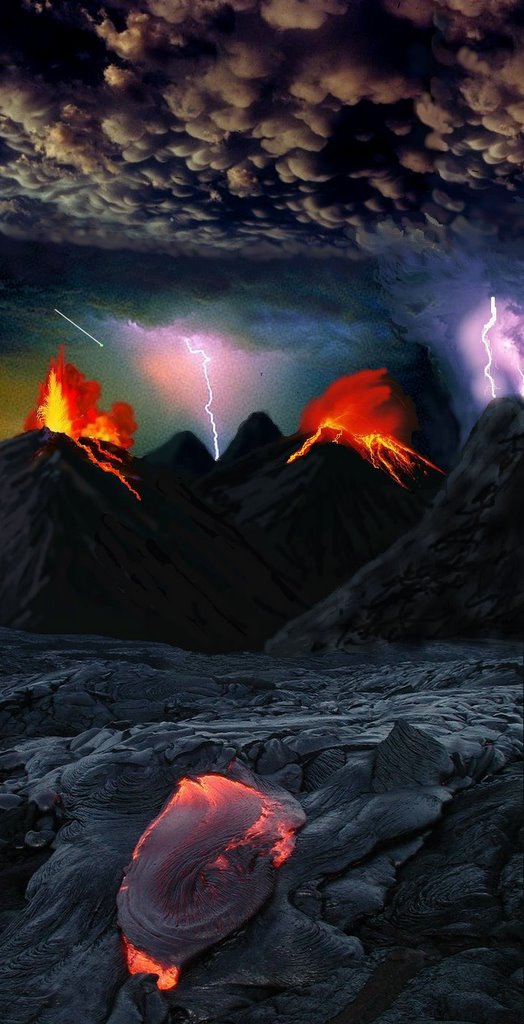
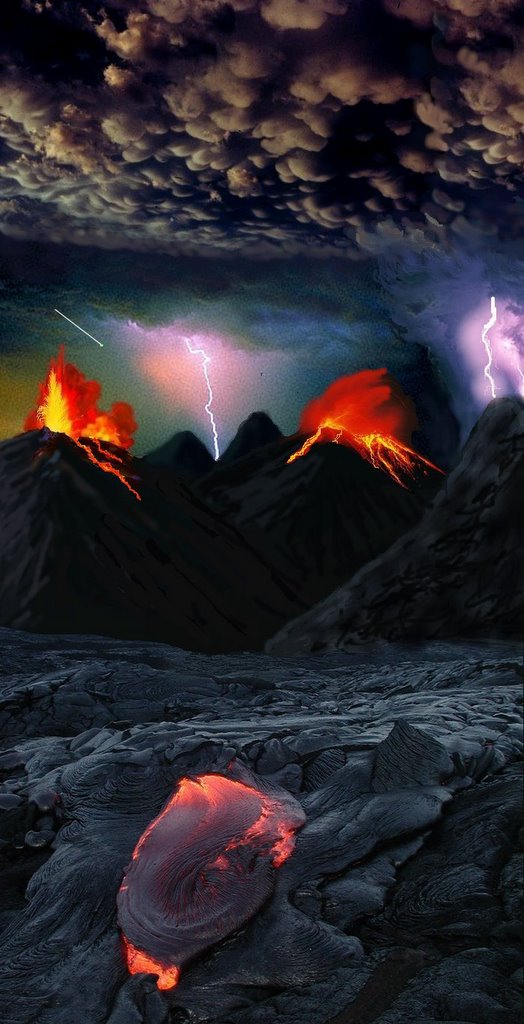
 When early Earth was cooling from its molten state, conditions would have been like hell on Earth – hence the name Hadean for this earliest segment of the Precambrian. Meteors rained down on the hot Earth, ultraviolet radiation was unchecked by an ozone belt, and volcanoes belched fumes into a thin reducing atmosphere, which sparked with lightning. The planet was differentiating into layers, and the earliest thin crust was probably composed predominantly of ultramafic rocks and was not unstable because it was subject to comparatively rapid cycles of melting. Successive partial meltings of the crust generated intermediate and ultimately felsic magmas, which formed volcanic island arcs. Movement of crustal material was driven by convection and by the close of the Hadean plutonic activity and collisions between island arcs had created several continental nuclei.
About 4.4-4.3 Ga, proto-oceans formed of water derived from volcanic outgassing and comets. With water came rain and erosion of igneous crustal rocks. Life, of course, had not yet evolved, but it may have had an earlier start than thought previously. Evidence indicates that life arose about 4 billion years ago, at the close of the Hadean Eon, and Cyanobacteria comprise the earliest known microfossils. The Cyanobacteria built large stromatolite reefs and dominated life for around 3 billion years (~4 Ga to ~1 Ga). The atmosphere remained reducing for much of the Achaean, though Cyanobacteria began to generate oxygen after approximately 2.8 to 2.7 Ga.
The term "hadean" was originally coined to designate the time before the earliest known rocks. However, rocks have been found that are older than the time-frame of the Hadean.
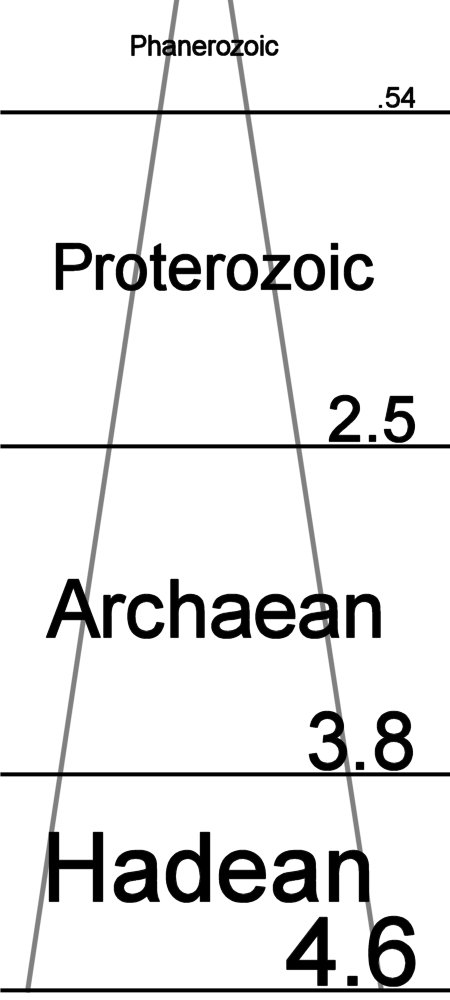
The Precambrian Eons include the first 4+ billion years of geological time until the Cambrian epoch opens the Phanerozoic eon:
● Hadean Eon
● Archaean Eon
● Proterozoic Eon.
 The Hadean Eon extends from Earth's formation until 3.8 billion years ago (Ga) and is succeeded by the Archean Eon (not to be confused with prokaryotic Archaea).
The Archaean lasted until 2.5 Ga and was originally designated to commence with the then earliest known rocks, and hence to mark the beginning of geological history on Earth. However, the Hadean includes 4.4 billion year old detrital zircon from Australia and 4.03 billion year old gneisses in Canada. While 3.7-3.8 billion year old rocks from Greenland sit astride the designated Hadean-Archaean boundary.
The Proterozoic Eon (inaccurately meaning pre-life) is the final Precambrian Eon and extends from 2.5 billion years ago to 540 million years ago. The Proterozoic is succeeded by the Phanerozoic ('visible life') Eon.
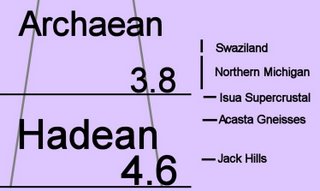 The oldest rocks so far discovered on Earth are:
1) Jack Hills, Western Australia, a 4.4 Ga detrital zircon (sample W74) in the Jack Hills metaconglomerate, Eranondoo Hill. More at Earliest Piece of Earth [news article]
2) The Acasta Gneisses near Canada’s Great Slave Lake (4.03 Ga) [image]
3) The Isua Supracrustal rocks of West Greenland (3.7 to 3.8 Ga)
4) Northern Michigan (3.5-3.7 Ga)
5) Swaziland (3.4-3.5 Ga)
“No known rocks have survived from the first 500 million years of Earth history, but studies of single zircons suggest that some continental crust formed as early as 4.4 Ga, 160 m.y. after accretion of the Earth, and that surface temperatures were low enough for liquid water. Surface temperatures are inferred from high d18O values of zircons. The range of d18O values is constant throughout the Archean (4.4-2.6 Ga) suggesting uniformity of processes and conditions. The hypothesis of a Cool Early Earth suggests long intervals of relatively temperate surface conditions from 4.4 to 4.0 Ga that were conducive to liquid-water oceans and possibly life. Meteorite impacts during this period may have been less frequent than previously thought.” A Cool Early Earth
Hadean proto-continents:
Earliest evidence for the Yilgarn craton comprises zircon crystals found in the Jack Hills of the Narryer Gneiss Terrane, Western Australia and also 300 km. south. These earliest known zircons suggest continental crust formation existent around 4.4-4.3 Ga. The high Oxygen-18 values of 8.5 and micro-inclusions of SiO2 within these zircon crystals are consistent with growth from a granitic source supracrustal material, with low-temperature interactions and a liquid ocean.
More: Introduction to the Hadean / Palaeos Hadean: The Hadean Eon / Geol 2C Hadean lecture / Evolution: Change: Deep Time / Geologic Time: Age of the Earth /


 When early Earth was cooling from its molten state, conditions would have been like hell on Earth – hence the name Hadean for this earliest segment of the Precambrian. Meteors rained down on the hot Earth, ultraviolet radiation was unchecked by an ozone belt, and volcanoes belched fumes into a thin reducing atmosphere, which sparked with lightning. The planet was differentiating into layers, and the earliest thin crust was probably composed predominantly of ultramafic rocks and was not unstable because it was subject to comparatively rapid cycles of melting. Successive partial meltings of the crust generated intermediate and ultimately felsic magmas, which formed volcanic island arcs. Movement of crustal material was driven by convection and by the close of the Hadean plutonic activity and collisions between island arcs had created several continental nuclei.
About 4.4-4.3 Ga, proto-oceans formed of water derived from volcanic outgassing and comets. With water came rain and erosion of igneous crustal rocks. Life, of course, had not yet evolved, but it may have had an earlier start than thought previously. Evidence indicates that life arose about 4 billion years ago, at the close of the Hadean Eon, and Cyanobacteria comprise the earliest known microfossils. The Cyanobacteria built large stromatolite reefs and dominated life for around 3 billion years (~4 Ga to ~1 Ga). The atmosphere remained reducing for much of the Achaean, though Cyanobacteria began to generate oxygen after approximately 2.8 to 2.7 Ga.
The term "hadean" was originally coined to designate the time before the earliest known rocks. However, rocks have been found that are older than the time-frame of the Hadean.
The Precambrian Eons include the first 4+ billion years of geological time until the Cambrian epoch opens the Phanerozoic eon:
● Hadean Eon
● Archaean Eon
● Proterozoic Eon.
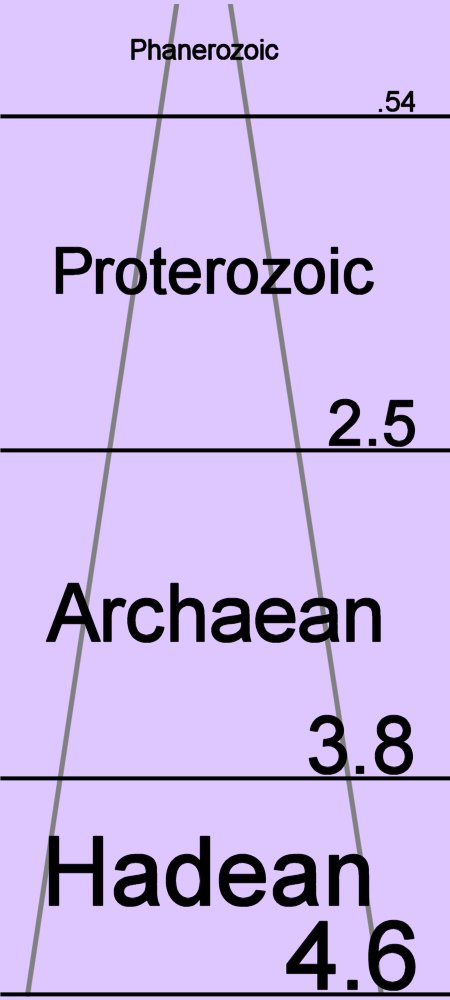 The Hadean Eon extends from Earth's formation until 3.8 billion years ago (Ga) and is succeeded by the Archean Eon (not to be confused with prokaryotic Archaea).
The Archaean lasted until 2.5 Ga and was originally designated to commence with the then earliest known rocks, and hence to mark the beginning of geological history on Earth. However, the Hadean includes 4.4 billion year old detrital zircon from Australia and 4.03 billion year old gneisses in Canada. While 3.7-3.8 billion year old rocks from Greenland sit astride the designated Hadean-Archaean boundary.
The Proterozoic Eon (inaccurately meaning pre-life) is the final Precambrian Eon and extends from 2.5 billion years ago to 540 million years ago. The Proterozoic is succeeded by the Phanerozoic ('visible life') Eon.
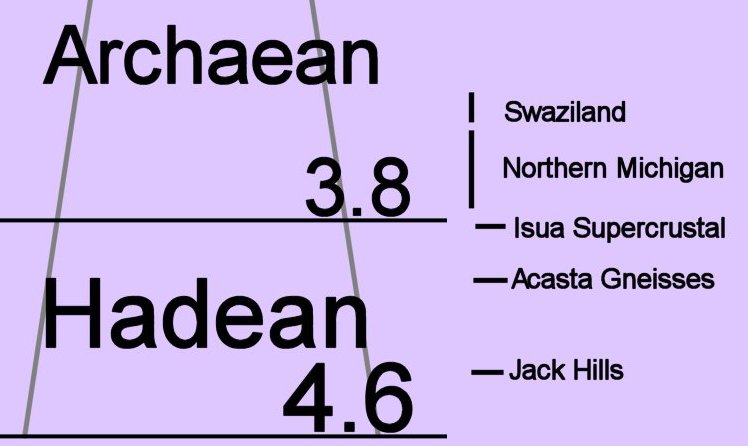 The oldest rocks so far discovered on Earth are:
1) Jack Hills, Western Australia, a 4.4 Ga detrital zircon (sample W74) in the Jack Hills metaconglomerate, Eranondoo Hill. More at Earliest Piece of Earth [news article]
2) The Acasta Gneisses near Canada’s Great Slave Lake (4.03 Ga) [image]
3) The Isua Supracrustal rocks of West Greenland (3.7 to 3.8 Ga)
4) Northern Michigan (3.5-3.7 Ga)
5) Swaziland (3.4-3.5 Ga)
“No known rocks have survived from the first 500 million years of Earth history, but studies of single zircons suggest that some continental crust formed as early as 4.4 Ga, 160 m.y. after accretion of the Earth, and that surface temperatures were low enough for liquid water. Surface temperatures are inferred from high d18O values of zircons. The range of d18O values is constant throughout the Archean (4.4-2.6 Ga) suggesting uniformity of processes and conditions. The hypothesis of a Cool Early Earth suggests long intervals of relatively temperate surface conditions from 4.4 to 4.0 Ga that were conducive to liquid-water oceans and possibly life. Meteorite impacts during this period may have been less frequent than previously thought.” A Cool Early Earth
Hadean proto-continents:
Earliest evidence for the Yilgarn craton comprises zircon crystals found in the Jack Hills of the Narryer Gneiss Terrane, Western Australia and also 300 km. south. These earliest known zircons suggest continental crust formation existent around 4.4-4.3 Ga. The high Oxygen-18 values of 8.5 and micro-inclusions of SiO2 within these zircon crystals are consistent with growth from a granitic source supracrustal material, with low-temperature interactions and a liquid ocean.
More: Introduction to the Hadean / Palaeos Hadean: The Hadean Eon / Geol 2C Hadean lecture / Evolution: Change: Deep Time / Geologic Time: Age of the Earth /
Image "Evolutionist"
Labels: Acasta Gneiss, accretion disk, Cyanobacteria, felsic magmas, Hadean, Isua supracrustal, microfossil, Precambrian Eons, proto-continents, stromatolite, ultramafic, volcanic island arcs, Yilgarn craton
| 0 Guide-Glossary