
Paleogeology

Paleogeology, Paleoclimate, in relation to Evolution of Life on Earth

Earth's structure

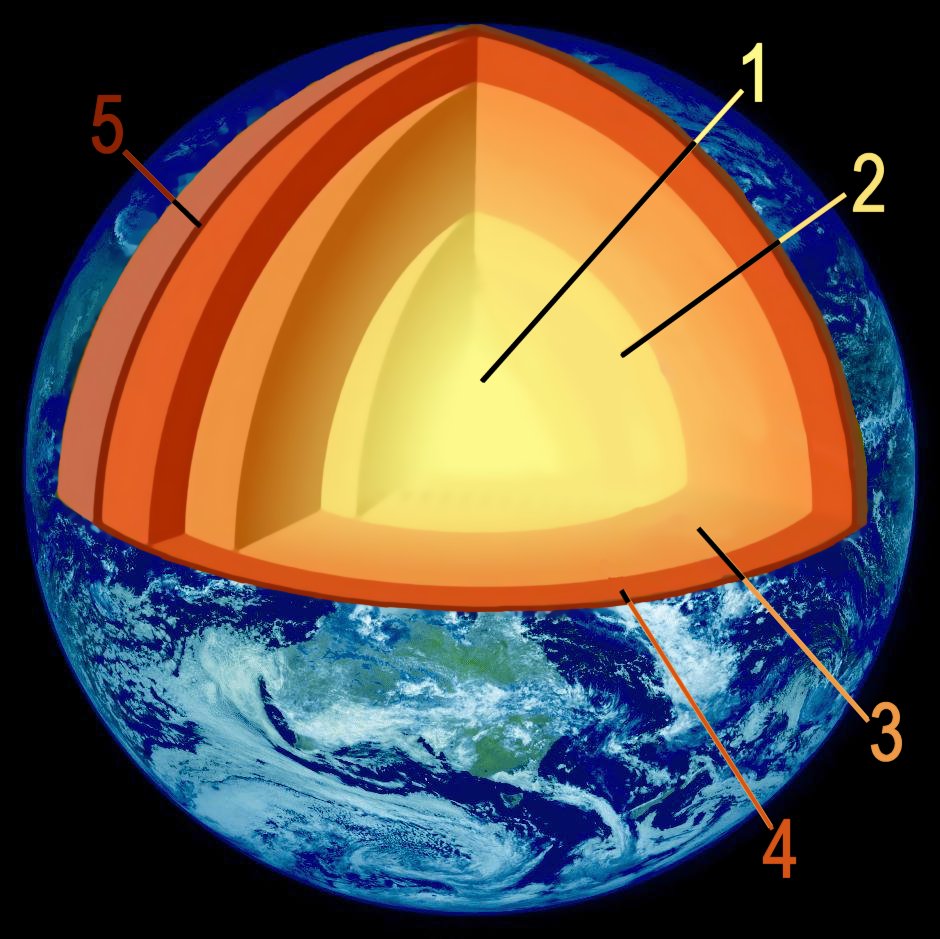
layers within Earth – higher temperature indicated by lighter colorThe Earth has several layers each with its own physical properties (left – higher temperature indicated by lighter color)

1. solid core – high pressures maintain the hot, mostly iron-nickel center in the solid state

2. liquid core – cooler than the solid inner core, but liquid because of lower pressures

3. inner mantle – 1000°- 4,000°C, the asthenosphere, or low velocity zone, is a plastic zone extending from the lithosphere to a depth of 250 km, perhaps as much as 400 km.

4. outer mantle – 500°C-900°C at boundary with crust, the outer mantle is part of the lithosphere that is relatively cool, chemically different than most of the mantle (mafic) and considered more resistant to deformation than the crust, extending from the Mohorovičić discontinuity (moho) to a depth of about 100-250 km

5. crust – the upper lithosphere is relatively light and brittle, composed of less dense felsic rocks, such as granites that have differentiated from melted mantle; typically about 25 miles thick beneath continents, and about 6.5 miles thick beneath oceans. The average thickness of the continental crust is about 35 to 40 km (image below right - click to enlarge), whereas that of oceanic crust is 7-10 km.

average thickness of the continental crustOceanic crust is younger than tectonic plate boundaries at continental margins.

The oldest oceanic crust dates from about 180 Ma (Jurassic) and lies adjacent to continents, while the youngest crust lies adjacent to the mid-oceanic ridge centers. The farther that oceanic crust lies outward from the mid-oceanic ridges, the older the rocks. The paleomagnetic signature of oceanic crust records geomagnetic reversals parallel to the ridge structures.

Because the continental crust is thrust up over oceanic crust at subduction zones, oceanic crust is consumed while continental crust survives. As a result, the Earth's oldest rocks are to be found within the cratonic cores of continents, and the oldest known continental rocks are Canada's Acasta Gneisses in the Slave Craton (Hadean tonalite gneiss, 4.03 Ga, image). A 4.2 Ga zircon xenocryst has been reported within a 3.9 Ga granitic rock of the Acasta Gneiss Complex [r, r2, im2].

Petrology:
The brittle, cool rocks of the crust belong to either the felsic continental crust or the mafic oceanic crust.

Rocks of the oceanic crust are mafic basaltic rocks (sima) with a mean density of about 3.3 grams per cubic centimeter (more dense than felsic continental rocks). With an average thickness of 10 km, the oceanic crust is thinner than the continental crust [image above right, crustal thickness].

The felsic continental crust average to approximately the composition of granodiorite. By virtue of its relative low density, continental crust is rarely subducted or re-cycled back into the mantle, although the collision of continental tectonic plates does cause the crust to thicken, causing melting of the deepest crustal rocks.

Mantle rock that lies shallower than about 400 km (4) comprises mostly olivine, pyroxenes, spinel, and garnets. Typical rock types are believed to be peridotite, dunite (olivine-rich peridotite), and eclogites. As predicted by laboratory investigations replicating high mantle pressures (diamond anvil), olivine is not stable between about 400 km and 650 km depth (upper 3), and is replaced by high pressure polymorphs with approximately the same composition. Olivine polymorphs include wadsleyite (beta-spinel type) and ringwoodite (gamma-spinel structure). Deeper than about 650 km (3), upper mantle minerals become increasingly unstable, so that the most abundant minerals have orthorhombic (pseudocubic) crystal structures (but not compositions) like that of the mineral, perovskite (CaTiO3). At high pressure conditions in the mantle, the pyroxene enstatite (MgSiO3) is a perovskite polymorph that may be the most common mineral in the Earth. The changes in mineralogy at about 400 and 650 km yield distinctive signatures in seismic records of the Earth's interior, and like the Moho are readily detected using seismic waves.

subduction zone magmas

Labels: , , , , , , , , , , , , , ,

| 0 Guide-Glossary

plate tectonic theory

relationship between tectonic plates and the circum-Pacific Plate tectonic theory provides a plausible mechanism for continental drift, explaining the concentration of earthquakes and 90% of volcanoes around the 'ring of fire'
(image at right –see interactive map of This Dynamic Planet).

Tectonism involves a variety of geological phenomena and structures associated with the large-scale movement of tectonic plates:
◘ earthquakes
explosion and extrusion of lava, and intrusion of magma (hypabassal, plutonic)
faulting - normal, thrust, transform, listric faultduplex structures, horse, horst & graben, klippes, nappes, shear zones, windows,
folding and deformationdécollement folds,
orogeny associated with continental-continental or continental-oceanic collision margins
magmatism
metamorphism
mid-oceanic ridge spreading centers and creation of oceanic crust
◘ rifting
shear zones
subduction zones and submarine trenches associated with continental-oceanic collision margins causing consumption of oceanic crust; associated with accretionary prisms, mélanges.
volcanic island arcs above subduction zones, and associated with generation of a variety of subduction zone magmas
volcanoes

The close fit between the modern continents that were once part of a single supercontinent (Pangaea).Continental drift explains the observed close fit between coast lines at opposite sides of the Atlantic (right) as well as the paleontological observation that equivalent, contemporaneous fossilized plants and animals can be found in continents and land masses that are now separated by oceans and seas.

The ocean floor is younger than the continental crust, and is arranged in parallel "stripes" of alternating magnetization parallel to the mid-oceanic ridges.

Earth's tectonic platesConsiderable evidence supports tectonic theory:
● Earth's crust is divided into several crustal plates (left - click to enlarge image) bounded by extensional, transform, or compressional stresses
ocean floors arise in chains of mid-oceanic ridges, and spread outward from these spreading centers, subducting beneath continental margins, where oceanic crust is melted (and subsequently regenerated at the ridges).
● sub-plate convection currents in the fluid asthenosphere circulates as convection currents underneath the solid lithosphere and move the crustal plates relative to one another (image below left)
● radioactivity deep in the Earth's mantle provides the source of heat that drives the convection currents

diagram of ocean cycle with new oceanic rocks formed where mantle convection cells rise beneath mid-oceanic ridges and consumed where oceanic plates subduct at ocean trenchesAs plates bump and grind, stresses build in the brittle lithosphere and the stored energy is ultimately released as earthquakes:
● at extensional boundaries where plates pull apart, such as spreading ridges, earthquakes are shallow, usually less than magnitude 8, and are aligned strictly along the axis of spreading.
● at transform faults where plates slide past each other, earthquakes are shallow (down to 25 km), usually smaller than magnitude 8, and exhibit strike-slip motion.
● at compressional boundaries between continental and oceanic crust, the plates collide with one another and one plate slides under the other (subduction), producing the largest earthquakes (some greater than magnitude 9) at depths that range from the very near surface to several hundred kilometers in depth (cool subducting plates can experience brittle failure as deep as 700 km)

subduction zone magmas

As an aid to understanding plate motion, divide the skin of an orange into square 'plates' and shift the sections relative to each other. To pull apart (extend) or push together (compress) the sections will require that edges at roughly 90 degrees to the direction of motion will slide past one another (transform).


history of plate tectonics theory : plate tectonics: mechanism :

images: This Dynamic Planet and tectonic plates courtesy of USGS

Labels: , , ,

| 0 Guide-Glossary

peridotite

xenolith of typical olivine-rich peridotite, cut by a centimeter-thick layer of greenish-black pyroxenite, San Carlos, southwestern US Peridotite is an ultramafic, ultrabasic (less than 45% silica), dense, plutonic igneous rock comprising mostly olivine and pyroxene. Most of the Earth's upper mantle (asthenosphere) is composed of peridotite that originated during the accretion and differentiation of the Earth, or that has differentiated, by precipitation of olivine ± pyroxenes, from basaltic or ultramafic magmas in turn derived from partial melting of the upper mantle peridotites. Deeper in the crust, olivine is replaced by a high pressure polymorphs, so peridotites do not occur at depths greater than 400 km.

Peridotite emplaced in the continental crust is typically found in obducted ophiolite complexes, as xenoliths in basalts and kimberlite pipes, and as orogenic peridotite massifs and alpine peridotites. Olivine is unstable at shallow depths and reacts rapidly with water, so that much surface peridotite has been altered to serpentinite by a process in which the pyroxenes and olivines are converted to green serpentine.


Labels: , , , , , , , , , , , , ,

. . . stratifying since 10/06/06