Paleogeology

Paleogeology, Paleoclimate, in relation to Evolution of Life on Earth

basalt

Basalt is a hard gray or black, mafic igneous volcanic rock that is usually fine-grained due to rapid cooling of lava, though it contain larger crystals in a fine matrix (porphyritic), be vesicular, or be a frothy scoria.

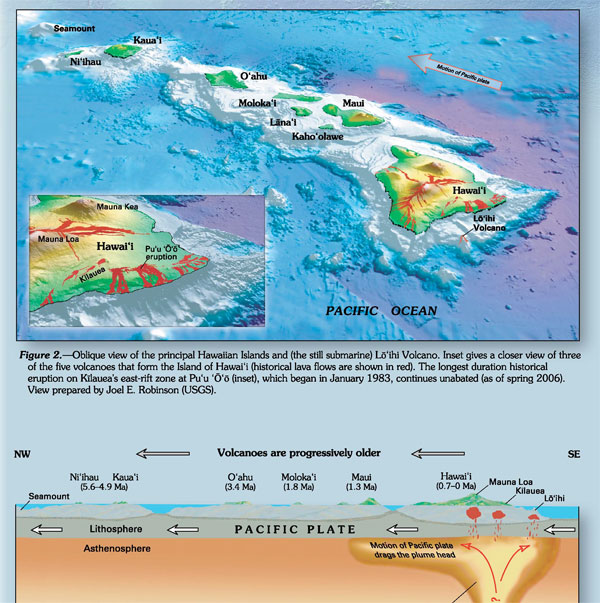
basaltic lava flow of aa over pahoehoe, Hawaii, courtesy of USGSBasalt magmas form by decompression melting of peridotite in the mantle. The crustal portions of oceanic tectonic plates comprised predominantly basalt, derived from upwelling peridotite in the mantle below ocean ridges. The basalt shield volcanoes of the Hawaiian island chain sit above a mantle plume, or 'hot spot'. (left - click to enlarge - aa flows over ropey pahoehoe in Hawaii - image courtesy of USGS.)

Basalt is TAS classified according to the relationships between the combined alkali content and the silica content. Basalt typically containts a preponderance of calcic plagioclase feldspar and pyroxene; olivine can also be a significant constituent. Accessory minerals include iron oxides and iron-titanium oxides, providing basalt with a paleomagnetic signature.

Phaneritic, shallow intrusive igneous rocks with a basaltic composition are generally referred to as dolerite (also called diabase) or gabbro.

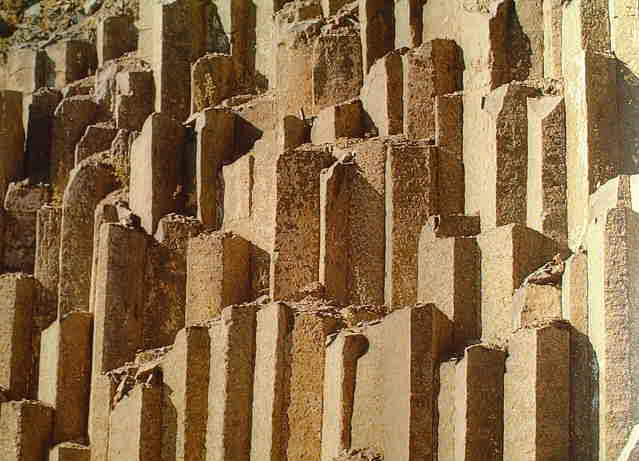
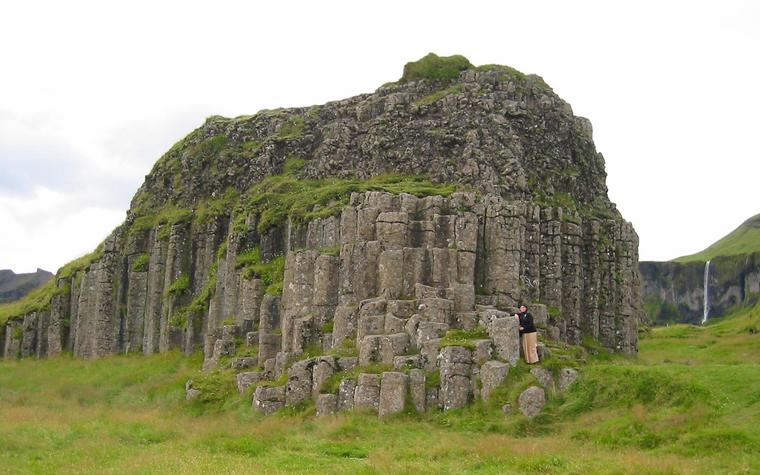
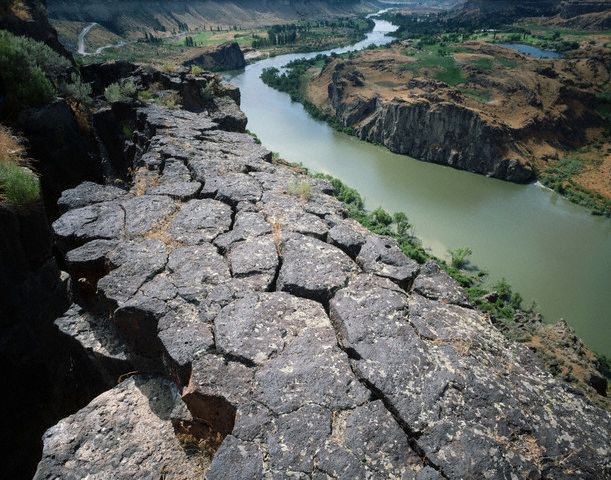
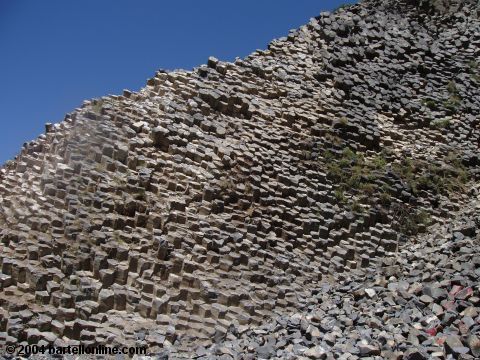
textures of various basalts - top-down: basaltic lava; lava field; flow-lines in basalt formation; close-up of vesicular basalt with olivine crystals; surface of basalt hand specimen; basalt columns.(image left - click to enlarge - courtesy USGS - top-down: basaltic lava; lava field; flow-lines in basalt formation; close-up of vesicular basalt with olivine crystals; surface of basalt hand specimen; basalt columns.)

[images - roll-over link for preview (where available); large images of hand-speciments (well worth a visit) show only as a corner on preview : water-sculpted basalt at Fossil Falls in Yosemite : Basalt Fall unterhalb des Hengifoss, basalt columns, Dverghamrar basaltic columns in Iceland, 2 : cliff of basalt columns : Columbia River basalts, Catherine Creek arch in Miocene columnar basalts : flowing curves of basalt entablature in Yellowstone : basalt columns Armenia : basalt field : basalt and sandstone : 3.7 Ga moon-rock basalt : hand-specimen : hand-specimen vesicular basalt, vesicular basalt with olivine phenocrysts, 2 : hand-specimen diabase : hand-specimen diabase porphyry : hand-specimen diorite : hand-specimen gabbro : hand-specimen scoria : thin-section basalt, 2, 3; thin-sections moon basalts ]

Labels: , , , , , , , , , , , , , ,

gabbro

close-up images of various gabbrosGabbro is a coarse-grained, mafic, plutonic igneous rock that forms at spreading centers in rift zones and mid-ocean ridges (so underlies oceanic crust). Gabbros can form as massive uniform intrusions or as layered ultramafic intrusions formed by settling of pyroxene and plagioclase (pyroxene-plagioclase cumulate).

As an essential component of the oceanic crust, gabbros are found in many ophiolite complexes in the sheeted dyke zone to massive gabbro zone (zones III and IV). Long belts of gabbroic intrusions are typical at proto-rift zones and around ancient rift zone margins, where they intrude into the rift flanks.

Gabbro is a dense rock that is greenish or dark-colored and comprises varied percentages of pyroxene, plagioclase feldspar, amphiboles, and olivine. Where olivine is present in large quantities, the rock is termed olivine gabbro.

A finer grained rock with the same composition as gabbro is termed diabase.

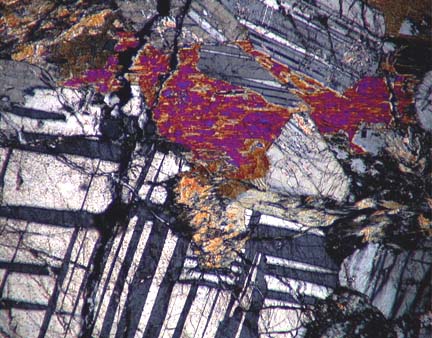
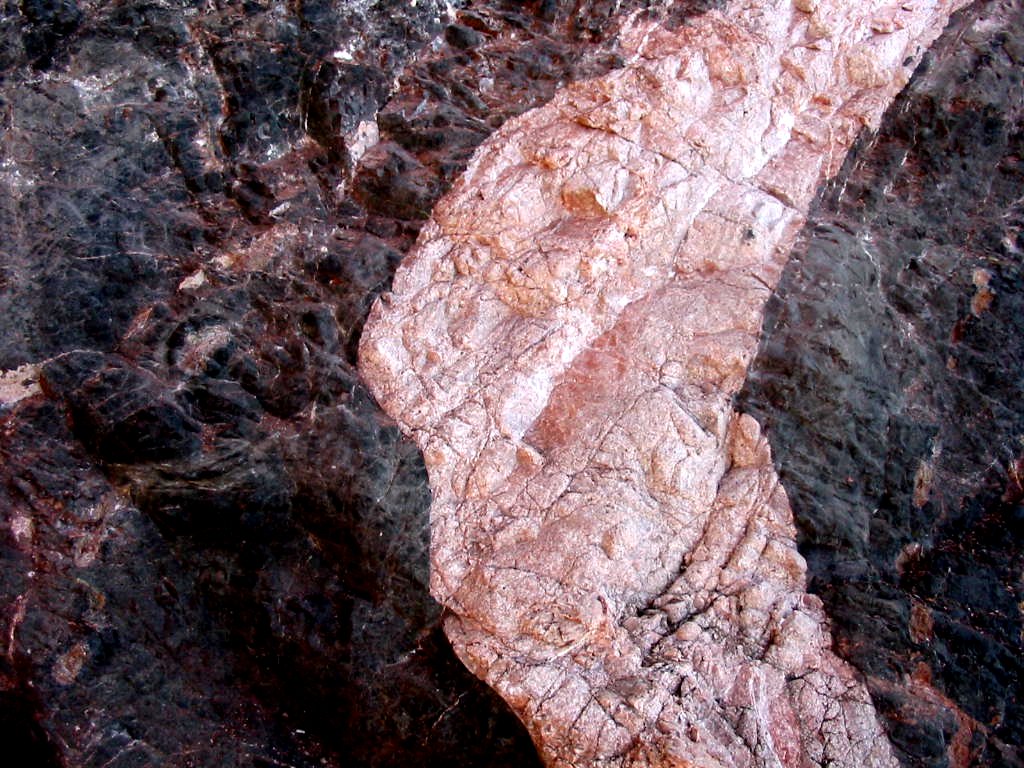
[images : layered gabbro, North Cascades : Salem gabbro-diorite cut by a a composite dike with felsic margins and a central core of basaltic rock : White Mountain Magma Series : pegmatitic gabbro : oceanic crust exposed on Cyprus : oceanic crust gabbro, 2 : thin section Oman Ophiolite gabbro : thin section of olivine gabbro - pyroxene and olivine show bright colours, striped grey rectangular crystals are plagioclase feldspar : thin section of gabbro with plagioclase and hypersthene (orthopyroxene) : hypersthene gabbro : thin section with pyroxene and (striped) plagioclases : thin section orthopyroxenes crystals surrounded by alteration (uralite) : thin section : thin section with twinned plagioclases :

Labels: , , , , , , , , ,

| 0 Guide-Glossary

granite

close-up images of various granitesGranite is typically a medium to coarse grained felsic, intrusive igneous rock (plutonic) that is usually pink to dark gray, sometimes black, depending on its chemistry and mineralogy. Granites are the commonest basement rocks of the continental crust, many dating from the Precambrian.

In some granites, individual crystals are larger than the groundmass (porphyrys). Granites primarily comprises orthoclase and plagioclase feldspars, quartz, hornblende, muscovite and/or biotite micas, with minor accessory minerals such as magnetite, garnets, zircon and apatite. Rarely, a pyroxene is present. Very rarely, iron-rich olivine, fayalite, occurs.

Granites are classified according to the QAPF diagram for granitoids and phaneritic foidolites (plutonic rocks) that compares the percentages of quartz, alkali feldspar (orthoclase, sanidine, or microcline) and plagioclase feldspar.

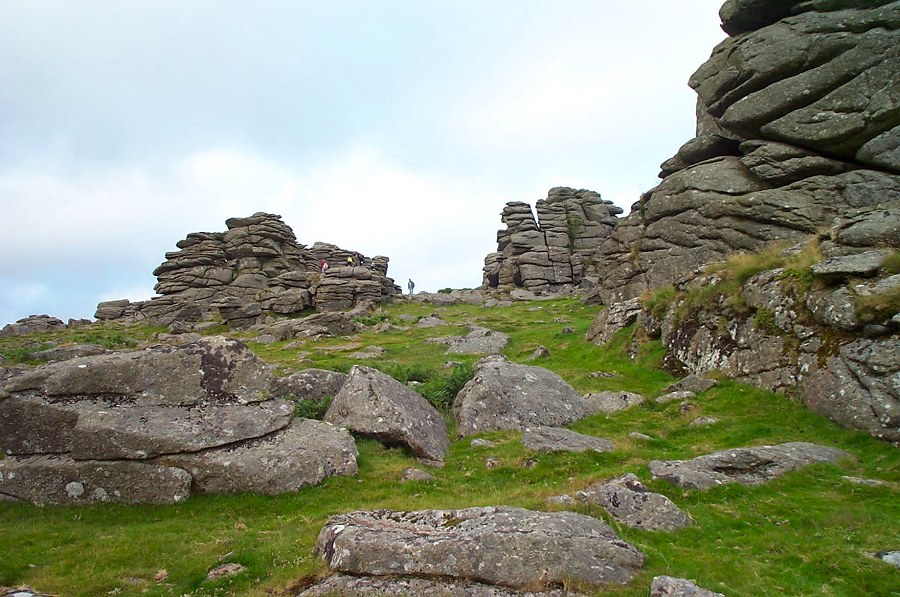
As a plutonic rock, granite is often exposed in weathered tors, dykes and as massive batholiths.

Labels: , , , , , , , , , , , , , , , , , ,

igneous rocks

texture and mineral composition of common intrusive and extrusive igneous rocksIgneous rocks result when molten rock cools (± crystallization) from plutonic (intruded) magma or from volcanic (extruded) lava.

Left - click to enlarge image - texture and mineral composition of common igneous rocks:

Increasing to the left: SiO2 content, viscosity; Increasing to the right: darkness, mafic : felsic composition, (Fe, Mg, Ca) : (K, Na) ratio, temperature of melting:

◘ a/p - aphanitic or porphyritic texture, derived from extruded magma (lava),
◘ 1. rhyolite ◘ 3. dacite ◘ 5. andesite ◘ 7. basalt
phaneritic texture, emplaced as magma (plutonic)
◘ 2. granite ◘ 4. granodiorite ◘ 6. diorite ◘ 8. gabbro to peridotite
0-100: percentage mineral content:
◊ a. quartz ◊ b. K-feldspar ◊ c. Na-feldspar ◊ pl. plagioclase to Ca-rich plagioclase ◊ d. muscovite
◊ e. biotite ◊ f. amphiboles ◊ g. pyroxenes ◊ h. olivine

Igneous rocks, predominantly plutonic, comprise about 95% of the Earth's crust, though their burial by sedimentary rocks and association with metamorphic rocks disguises their true extent.
The crystalline basement rock (shield) at the core of most continents is ancient, having arisen predominantly during a period from 3.0 to 2.5 billion years ago, which was the period of maximum continent formation. Most of the earliest rocks have been greatly altered through regional metamorphic processes, but later rocks (3.2-2.5 Ga) are mostly pillow-basalts that formed beneath the vast oceans. Archean sedimentary rocks are mostly coarse and poorly sorted sandstones and conglomerates.

Labels: , , , , , ,

| 0 Guide-Glossary

magma

Magma is molten rock, which forms igneous rock when it crystallizes on cooling as igneous intrusions or extruded lava.

Most magma comprises solutions of silicates melted at temperatures from 700-1600 °C depending upon the environment in which the parent rock melted. Unusual black lava carbonates (natrocarbonatite) of the intracontinental volcano Oldoinyo Lengai are molten at temperatures as low as 600 °C.

The melting of rock is determined by temperature, pressure, and composition and occurs in association with mantle plumes or tectonic processes. The composition of magma can alter after melting of the parent rock by processed that include contamination, fractional crystallization, and mixing of magma with other molten rock.

dry rock with partial melts of liquid and crystalswet rock with partial melts comprising liquid, crystals, and vapor
Rocks melt at a range of temperatures, depending upon pressure and the presence of water and gases. Greater temperatures are required to melt a given dry rock at greater pressures, whereas wet rocks initially melt at decreasing temperatures with increasing pressure and then transition to requiring greater temperatures with further increase in pressure. (above left -dry rock with partial melts of liquid and crystals; above right - wet rock with partial melts comprising liquid, crystals, and vapor).

Burial of rock exposes the minerals to heating along the geothermal gradient, which is elevated by convection within the asthenosphere, bringing the rock to temperatures high enough for partial melting. dry melt compared to geothermal gradient and geothermal gradient raised by convection

The geothermal gradient is defined as the rate of change of temperature (ΔT) with depth (ΔZ), in the Earth. At depths down to about 60 m, temperature is constant at about 11°C. Between 60 and 120 m, the geothermal gradient is variable because it is affected by atmospheric changes and circulating ground water. Below 120 m, temperature almost invariably increases with depth, though the rate of increase with depth varies with both tectonic setting and the thermal properties of the rock.

High gradients (up to 200°C/km) are observed along oceanic spreading centers and along island arcs due to magma rising to the surface. Low gradients are observed in tectonic subduction zones because of cold, water-filled sediments thrusting beneath the existing crust. Tectonically stable shield areas and sedimentary basins have average gradients that typically vary from 15–30°C/km.

◙ subduction zone magmas ◙

Labels: , , , ,

peridotite

xenolith of typical olivine-rich peridotite, cut by a centimeter-thick layer of greenish-black pyroxenite, San Carlos, southwestern US Peridotite is an ultramafic, ultrabasic (less than 45% silica), dense, plutonic igneous rock comprising mostly olivine and pyroxene. Most of the Earth's upper mantle (asthenosphere) is composed of peridotite that originated during the accretion and differentiation of the Earth, or that has differentiated, by precipitation of olivine ± pyroxenes, from basaltic or ultramafic magmas in turn derived from partial melting of the upper mantle peridotites. Deeper in the crust, olivine is replaced by a high pressure polymorphs, so peridotites do not occur at depths greater than 400 km.

Peridotite emplaced in the continental crust is typically found in obducted ophiolite complexes, as xenoliths in basalts and kimberlite pipes, and as orogenic peridotite massifs and alpine peridotites. Olivine is unstable at shallow depths and reacts rapidly with water, so that much surface peridotite has been altered to serpentinite by a process in which the pyroxenes and olivines are converted to green serpentine.


Labels: , , , , , , , , , , , , ,

rocks

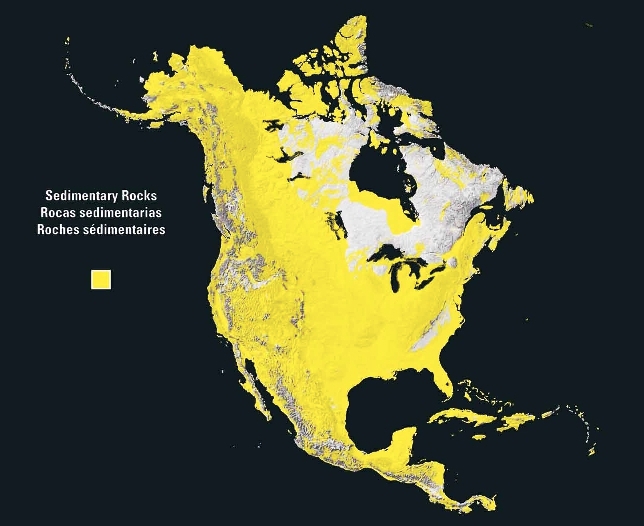
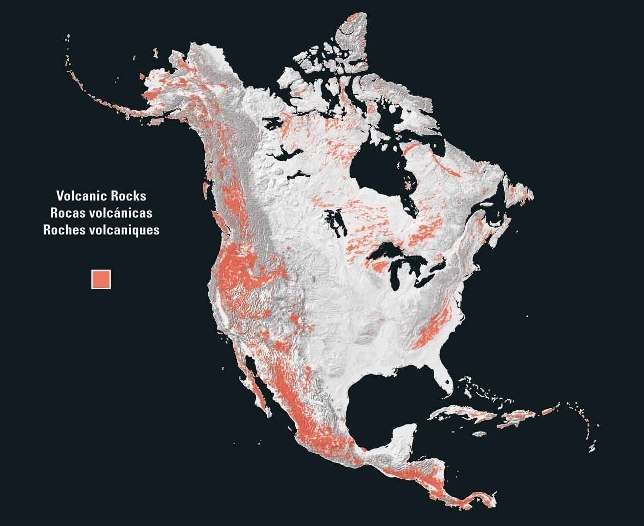
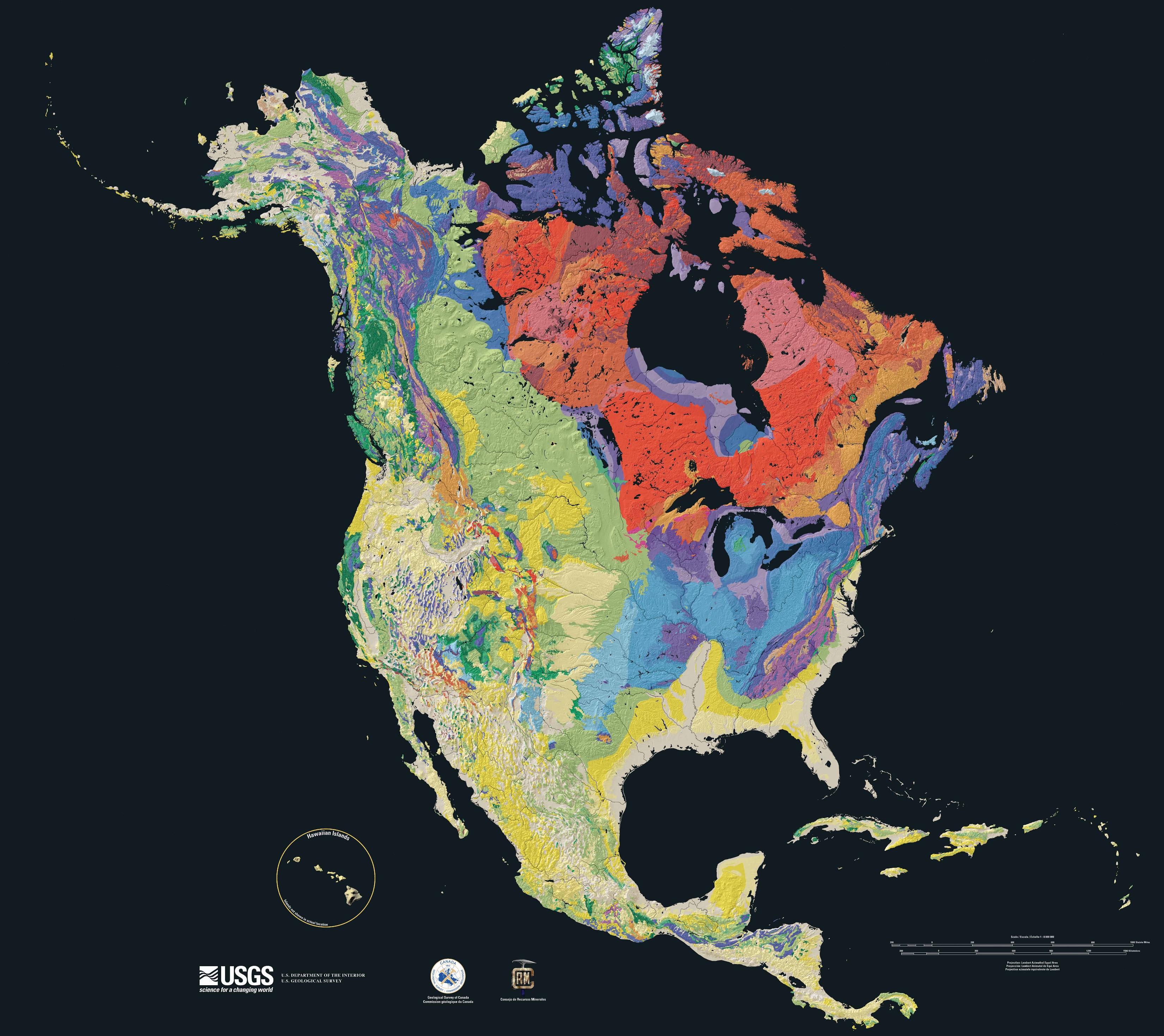
Maps of North American rock types : rock types - metamorphic, plutonic, sedimentary, volcanic; tapestry of time and terrain, terrain ▪ North American Craton

Petrology ◘ basalt ◘ breccia ◘ felsic (sial) ◘ gabbro ◘ granite ▪ greenstone belts ◘ hornfels ◘ igneous rocks ◘ lava ◘ mafic (sima) ◘ magma ◘ metamorphic rocks ◘ peridotite ▪ porphyry ▪ plutonic ◘ rocks ◘ sedimentary rocks ▪ texture ▪ xenoliths ▪

Mineralogy ◘ crystallization ▪ phenocryst

Tables Geology Section  Elemental Composition of Crust  Flood Basalts and Stratigraphic Boundaries  Minerals & Rocks: Carbonates  Minerals & Rocks: Evaporates, Sulphates  Minerals & Rocks: Metamorphic  Minerals & Rocks: Oxides  Radiometric Dating  Volcanoes  Weathering of Minerals 

images : Rock gallery :

Labels: , , , , ,

| 0 Guide-Glossary

paleomagnetism

Paleomagnetism is used to determine Earth's ancient magnetic orientation and the orientation of rock bodies relative to the magnetic poles at the time of rock formation.

Paleomagnetic studies employ the phenomenon in which magnetic minerals, such as magnetite, record the Earth's magnetic field at the time of solidification of magma or lava (Curie temperature). [image computer simulation of Earth's magnetic field] This magnetic record of prior magnetic orientation is termed thermal remnant magnetism (TRM) for igneous and metamorphic rocks, and detrital (depositional) remnant magnetism (DRM) for sedimentary rocks in which individual grains of magnetic minerals align with the magnetic field during their deposition as sediments. Chemical remnant magnetism (CRM) can be detected in some rocks as magnetic grains are deposited from circulating solutions.

Paleomagnetism has been employed to:
● map sea floor spreading as basaltic oceanic crust spreads from its line of formation along mid-ocean ridges, providing strong empirical support for theories regarding plate tectonics as a mechanism for continental drift [diagram, magnetic stripes, ridges, ridges 2, ridges 3]
● map polar wandering
● determine past global positions of ancient rock formations or terranes (when combined with radiometric determination of the age of a rock formation)
● constraining possible ages for rocks and for geologic processes
● reconstructions of deformational histories of segments of the crust.

: e-Book Magnetic Domains to Geologic Terranes (pdf) : e-Book Lectures in Paleomagnetism (html or pdf) : paleomagnetism analyses USGS : The Geodynamo :

news and articles : Earth's Inconstant Magnetic Field (NASA) : Earth Magnetic Field Reversal : Earth's Magnetic Field Is Fading & Earth's Core Spins Faster Than Surface, Study Confirms & Magnetic Field Weakening in Stages, Old Ships' Logs Suggest & Why Does Earth's Magnetic Field Flip? & North Magnetic Pole Is Shifting Rapidly Toward Russia & "Magnetic Map" Found to Guide Animal Migration & Magnetic Beaks Help Birds Navigate, Study Says & Migrating Birds Reset "Compasses" at Sunset, Study Says & Bats Use Magnetic "Compasses" to Navigate, Study Says & Lobsters Navigate by Magnetism, Study Says & Space Dust Flooding Our Solar System & New Solar Telescope Would Focus on Sunspots, Storms National Geographic :

Labels: , , , , , , , , , , ,

| 0 Guide-Glossary

. . . stratifying since 10/06/06