Paleogeology

Paleogeology, Paleoclimate, in relation to Evolution of Life on Earth

hydrothermal metamorphism

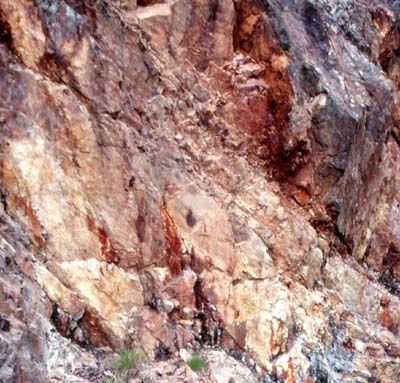
Hydrothermal metamorphism results from the interaction of a rock with high-temperature fluids, producting metamorphic and metasomatic reactions that depend upon temperature and compositional differences between the country rock and the invading fluid.

The hydrothermal fluid may be:
● magmatic (originating in an intruding magma)
● circulating groundwater
● ocean water

Convective circulation of saline in ocean floor basalts produces extensive hydrothermal metamorphism adjacent to spreading centers and in other submarine volcanic areas. Patterns of hydrothermal alteration are used as guides in the search for deposits of valuable metallic ores.

[links: images: pyritized rocks (form a halo around the copper deposit) and result from percolation of chemically-reactive hot groundwaters through the strata]

Labels: , , , , , , , ,

basalt

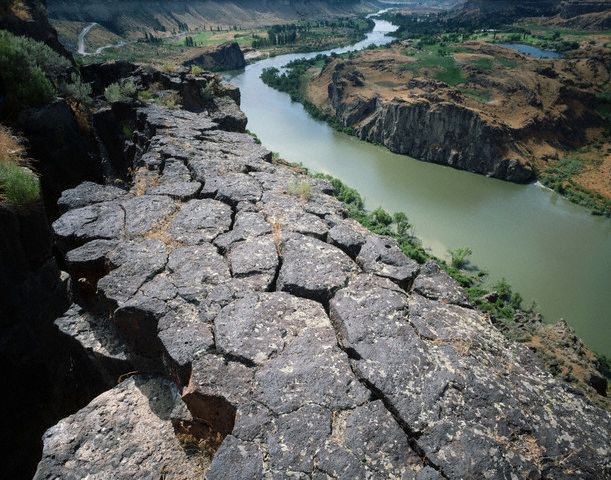
Basalt is a hard gray or black, mafic igneous volcanic rock that is usually fine-grained due to rapid cooling of lava, though it contain larger crystals in a fine matrix (porphyritic), be vesicular, or be a frothy scoria.

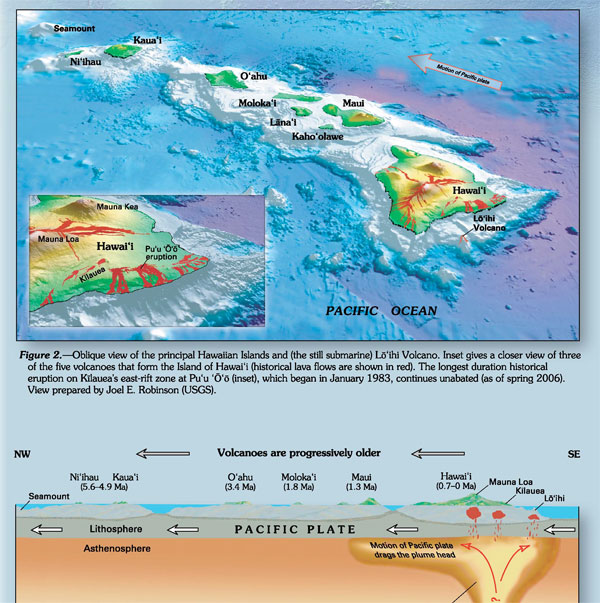
basaltic lava flow of aa over pahoehoe, Hawaii, courtesy of USGSBasalt magmas form by decompression melting of peridotite in the mantle. The crustal portions of oceanic tectonic plates comprised predominantly basalt, derived from upwelling peridotite in the mantle below ocean ridges. The basalt shield volcanoes of the Hawaiian island chain sit above a mantle plume, or 'hot spot'. (left - click to enlarge - aa flows over ropey pahoehoe in Hawaii - image courtesy of USGS.)

Basalt is TAS classified according to the relationships between the combined alkali content and the silica content. Basalt typically containts a preponderance of calcic plagioclase feldspar and pyroxene; olivine can also be a significant constituent. Accessory minerals include iron oxides and iron-titanium oxides, providing basalt with a paleomagnetic signature.

Phaneritic, shallow intrusive igneous rocks with a basaltic composition are generally referred to as dolerite (also called diabase) or gabbro.

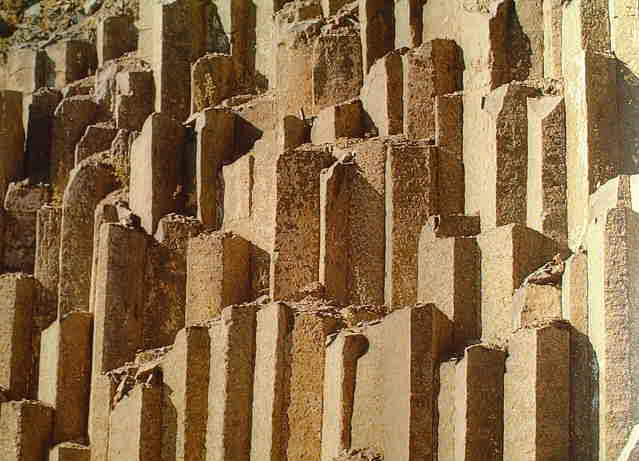
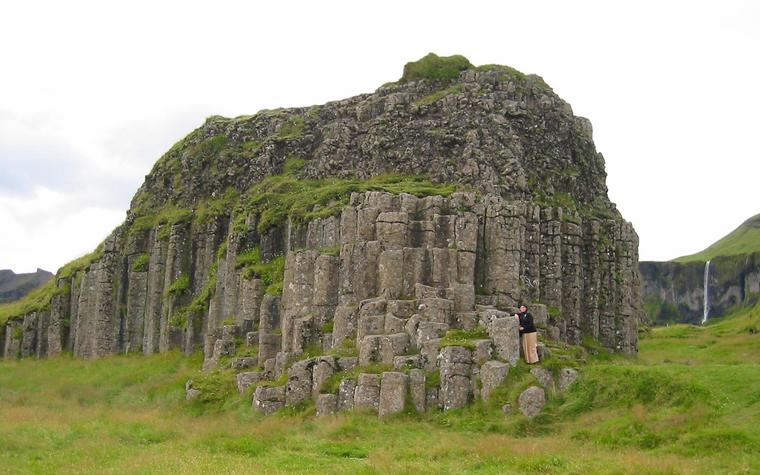
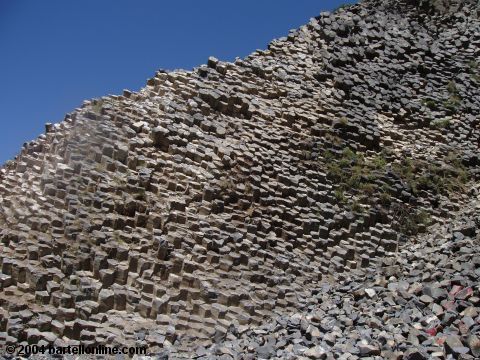
textures of various basalts - top-down: basaltic lava; lava field; flow-lines in basalt formation; close-up of vesicular basalt with olivine crystals; surface of basalt hand specimen; basalt columns.(image left - click to enlarge - courtesy USGS - top-down: basaltic lava; lava field; flow-lines in basalt formation; close-up of vesicular basalt with olivine crystals; surface of basalt hand specimen; basalt columns.)

[images - roll-over link for preview (where available); large images of hand-speciments (well worth a visit) show only as a corner on preview : water-sculpted basalt at Fossil Falls in Yosemite : Basalt Fall unterhalb des Hengifoss, basalt columns, Dverghamrar basaltic columns in Iceland, 2 : cliff of basalt columns : Columbia River basalts, Catherine Creek arch in Miocene columnar basalts : flowing curves of basalt entablature in Yellowstone : basalt columns Armenia : basalt field : basalt and sandstone : 3.7 Ga moon-rock basalt : hand-specimen : hand-specimen vesicular basalt, vesicular basalt with olivine phenocrysts, 2 : hand-specimen diabase : hand-specimen diabase porphyry : hand-specimen diorite : hand-specimen gabbro : hand-specimen scoria : thin-section basalt, 2, 3; thin-sections moon basalts ]

Labels: , , , , , , , , , , , , , ,

breccia

basaltic breccia with epidote groundmass.Breccias are clastic, sedimentary rocks comprising angular fragments from a previous rock structure that have been cemented in a matrix.
image: basalt breccia with epidote groundmass, courtesy of Siim Sepp

Classification of breccias relates to their constituents, mode of occurrence, constituent fragment size, types of clasts, and source of clasts.

Many breccias comprise consolidated talus or scree material, and are made up of accumulations of rock fragments that have fallen down steep hill slopes or cliffs. Breccia are often found above uncomformities, and so are associated with conglomerate, arkose and sandstone. (Conglomerates have rounded fragments.) Other breccias are produced by the fragmentation of rocks during faulting (tectonic or monomictic breccia), or during volcanic eruptions (eruption breccia, vent breccia), or collapses such as in karst areas, or form upon meteorite impacts (often in breccia dikes). Monomictic breccias result from rock deformation by shearing and granulation (cataclasis) in the process of tectonism or dislocation metamorphism, while impact breccias have been called "monomictic movement breccias".

[images: hand-specimens: breccia, 2, 3, 4, chert breccia; breccia in copper, 2; impact breccia; thin-sections : volcanic breccia; fault breccia in the Antietam Formation; Breccia Pernice marble, Breccia Aurora marble; formations: cliffs of volcanic breccias formed by lahars; Wawa xenolithic breccia, Wawa Heterolithic Breccia; Ries impact structure, Iggenhausen quarry, monomictic movement breccia, close-up; Azuara impact structure close-up; grit brecciation and mortar texture, Rubielos de la Cérida impact basin, and heavily brecciated and polished scour surface; strongly brecciated chert nodule, Malmian limestone, Ries impact structure; breccia dikes in Liassic limestones south of Belchite (Deutsche)]

Labels: , , , , , , ,

. . . stratifying since 10/06/06