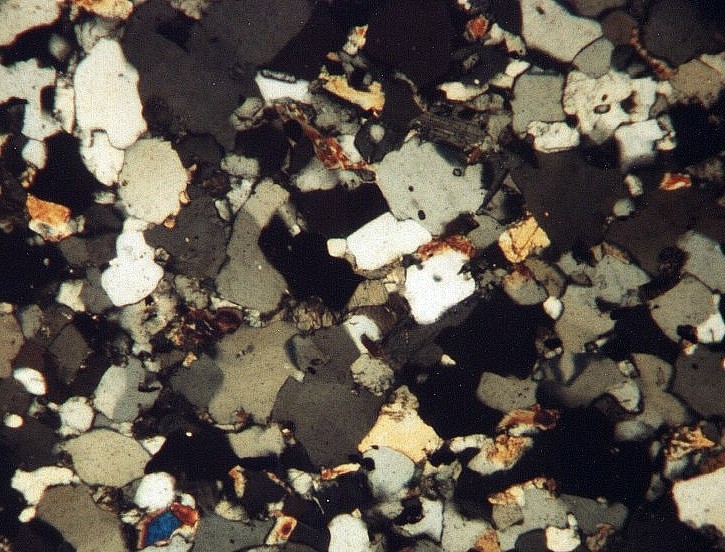


hornfels
Hornfels are hard, mostly fine-grained metamorphic rocks that results from contact metamorphism.
 Banding from the country rock can be retained, but because original bedding planes have typically been lost from the country rock upon baking by intruding magma, hornfels tend to separate into cubical fragments rather than into thin plates. Hornfels display characteristic mosaic-like interlocking of minerals, sometimes with enclosed particles of the other minerals [3]. The minerals rarely show crystalline form and are typically of nearly equal dimensions. The interlocking, equidimensional texture has been called pfiaster or pavement structure [photomicrographs 1, 2, 3, 4, 5, 6, 7, 8, 9, 10, 11]
Hornfels types and mineral assemblages depend upon the country rock that was baked during contact metamorphism:
● biotite hornfelses (the commonest) derive from slates, shales and clays
● calcite-silicate-hornfelses from impure limestone (purer limestones recrystallize as marbles)
● hornfelses with eldspar with hornblende (generally of brown color) and pale pyroxene arise from diabases, basalts, and andesites
Whole specimens range are dense, dull (not shiny), may be spotted, and vary in color : biotite hornfelses from slates, shales and clays are dark-brown to black; lime hornfelses are often white, yellow, pale-green, or brown; andalusite may be pink and pleochroic.
Some hornfels do retain layering [1]
hand specimens : andalusite hornfels : graywacke : hornfels : hornfels (Løkken Verk) : hornfelse :
by location : St Sjöfallet : Triangle Lake : Svenådalen :
rock outcrops : Tonschiefer-Hornfels : New Zealand : Japan :
photomicrographs : andalusite hornfels : biotite hornfels : biotite hornfels 2 : cordierite hornfels : garnet hornfels : pyroxene hornfels : sillimanite hornfels : spotted hornfels

 Banding from the country rock can be retained, but because original bedding planes have typically been lost from the country rock upon baking by intruding magma, hornfels tend to separate into cubical fragments rather than into thin plates. Hornfels display characteristic mosaic-like interlocking of minerals, sometimes with enclosed particles of the other minerals [3]. The minerals rarely show crystalline form and are typically of nearly equal dimensions. The interlocking, equidimensional texture has been called pfiaster or pavement structure [photomicrographs 1, 2, 3, 4, 5, 6, 7, 8, 9, 10, 11]
Hornfels types and mineral assemblages depend upon the country rock that was baked during contact metamorphism:
● biotite hornfelses (the commonest) derive from slates, shales and clays
● calcite-silicate-hornfelses from impure limestone (purer limestones recrystallize as marbles)
● hornfelses with eldspar with hornblende (generally of brown color) and pale pyroxene arise from diabases, basalts, and andesites
Whole specimens range are dense, dull (not shiny), may be spotted, and vary in color : biotite hornfelses from slates, shales and clays are dark-brown to black; lime hornfelses are often white, yellow, pale-green, or brown; andalusite may be pink and pleochroic.
Some hornfels do retain layering [1]
hand specimens : andalusite hornfels : graywacke : hornfels : hornfels (Løkken Verk) : hornfelse :
by location : St Sjöfallet : Triangle Lake : Svenådalen :
rock outcrops : Tonschiefer-Hornfels : New Zealand : Japan :
photomicrographs : andalusite hornfels : biotite hornfels : biotite hornfels 2 : cordierite hornfels : garnet hornfels : pyroxene hornfels : sillimanite hornfels : spotted hornfels
Labels: bedding planes, contact metamorphism, hornfels, magmatic intrusion, minerals, pavement structure, pfiaster